
How Customer Identity Platforms Reduce Bad Data
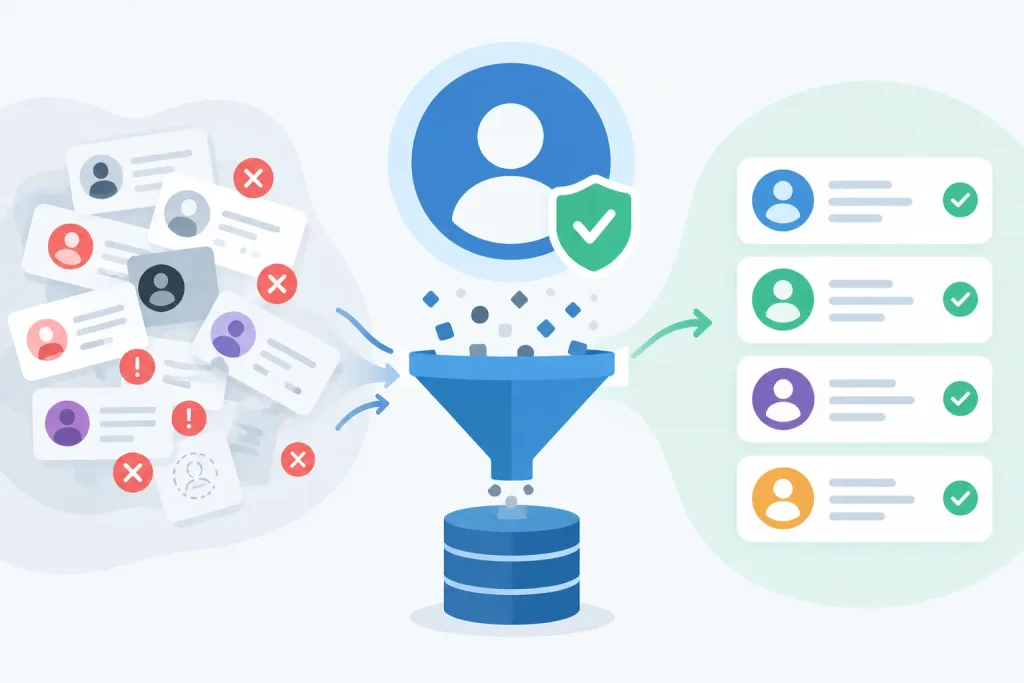
A lead form can look complete while still creating an operational loss. The phone number may be disconnected, the name may not align with the submitted address, the email may belong to a disposable account, or the consumer may never have intended to engage. Customer identity platforms address this problem before a record is routed to a sales queue, a lender, a CRM, or an outbound messaging program.
For organizations handling consumer data at scale, identity is not only a security concern. It determines whether media spend produces reachable prospects, whether agents spend time on viable conversations, whether authentication is defensible, and whether outreach workflows can withstand compliance scrutiny. The cost of bad data is cumulative: failed calls, wasted texts, duplicate records, poor conversion rates, carrier filtering, fraud losses, and incomplete audit trails.
What customer identity platforms do
Customer identity platforms establish confidence in the consumer data an organization collects, receives, or purchases. They evaluate identity attributes and contact information to determine whether a record is valid, reachable, consistent, and appropriate for the intended workflow.
That function is broader than a basic form validator. Checking whether a phone field contains 10 digits does not establish whether the number is active, mobile, reassigned, associated with the consumer, or suitable for a text-based authentication step. Likewise, confirming that an address exists does not prove that a submitted identity is credible enough for lending, account creation, or high-value lead routing.
A capable platform can provide signals at the point of capture, during a batch review, or at the moment a record enters a downstream system. Depending on the use case, those signals may include phone status, line type, identity match results, reverse lookup and data append results, one-time passcode outcomes, and credit-based verification inputs.
The goal is not necessarily to reject every record with an imperfect signal. The goal is to make routing decisions with more evidence. A disconnected number might be rejected immediately. A record with partial identity alignment may be sent to a manual review queue. A verified mobile number paired with successful one-time passcode authentication can move directly to an agent or approved account flow.
Why identity quality belongs at intake
Many teams try to solve data quality after the fact. They run periodic database cleanses, remove obvious duplicates, and suppress contacts after repeated outreach failures. Those controls have value, but they act after money has already been spent and operational capacity has already been consumed.
Verification at intake changes the economics. When a paid lead is submitted, a real-time phone check can identify an invalid or unreachable number before the lead is sold, distributed, or dialed. When a new user creates an account, identity verification can detect mismatched information before access is granted. When a consumer requests a quote, an authentication step can help distinguish an actual prospect from an automated submission.
This matters especially in environments where records move quickly. A lead may be posted to several buyers within seconds. A call center may prioritize it immediately. A financial services workflow may use it to trigger disclosures, eligibility checks, or consent-sensitive communications. By the time a nightly batch process identifies a bad record, the operational damage may already be done.
Point-of-capture verification also produces cleaner evidence. Teams can retain the result tied to the original submission, including timestamps, verification outcomes, and the action taken. That creates a clearer audit trail than trying to reconstruct why a record was accepted days or weeks later.
Identity confidence is not a single score
A common mistake is treating identity as a pass-or-fail event. In practice, acceptable confidence depends on the action being taken. Sending a low-risk confirmation message may require less certainty than opening a financial account, extending credit, or transferring a consumer to a licensed representative.
The right platform supports this distinction. It should allow an organization to apply different verification thresholds by workflow, channel, customer segment, or risk level. A marketing team may need to know whether a number is active and mobile. A fraud team may need stronger identity corroboration. A compliance team may require documented consent and authentication evidence before certain communications occur.
That flexibility prevents two expensive outcomes: accepting poor-quality records because controls are too weak, or discarding valid prospects because controls are too rigid.
Where customer identity platforms create measurable value
The strongest use cases are usually tied to a specific operational failure. Rather than treating verification as a generic data enrichment project, organizations should map it to the decision that needs to improve.
For lead generation teams, the priority is often stopping fake, duplicate, unreachable, or low-intent submissions before they enter buyer routing. Phone status checks and identity signals can improve lead acceptance rates, reduce make-good disputes, and protect the quality of inventory delivered to downstream partners.
For call centers, verified contact data improves agent productivity. Fewer disconnected numbers and misrouted leads mean more time spent on real conversations. Phone intelligence can also help teams distinguish mobile, landline, and other line types so outreach strategies reflect the channel actually available to the consumer.
For texting programs, contact verification supports deliverability and carrier reputation. Messaging invalid, reassigned, or unsuitable numbers increases waste and can contribute to negative performance signals. Verification does not replace consent management, but it helps ensure that consent-driven campaigns are directed toward viable endpoints.
For fintech, lending, and account-opening workflows, identity verification and soft credit pull capabilities can reduce friction while improving decision quality. The appropriate level of verification depends on the product, regulatory obligations, and risk appetite. A lightweight check may be enough to screen an initial inquiry, while a higher-risk decision may require stronger corroboration and documented review.
For data platform teams, batch processing helps improve existing databases without forcing a full rebuild of legacy systems. Records can be assessed through API, FTP, or manual upload workflows, then returned with actionable fields that support suppression, prioritization, enrichment, or review.
The platform decision is really an architecture decision
Customer identity platforms are sometimes evaluated as a standalone fraud tool or a marketing data product. That framing is too narrow. The more useful question is where verification belongs in the organization’s data flow.
For a modern application, real-time API delivery may be the right fit. Verification results can inform the user experience immediately, such as requiring an OTP challenge, blocking a suspicious submission, or escalating a record to review. The trade-off is implementation work: product and engineering teams must define failure handling, response timing, and customer-facing messaging.
For established operations with multiple vendors and older systems, file-based processing may be more practical. A scheduled batch can verify purchased leads, cleanse a contact database, or evaluate records before a campaign launch. This approach is easier to adopt in some environments, though it cannot prevent a bad record from entering a system in the same way as real-time verification.
Many organizations need both. They use live checks at high-risk or high-volume intake points and batch verification to improve historical data, monitor changes in phone status, and apply new policy rules across existing records.
Signals need operating rules
A verification result has limited value if no one owns the next action. Before selecting a provider, teams should define what happens when a number is invalid, an identity does not match, an OTP fails, or a record lacks sufficient data.
This is where commercial, product, operations, and compliance leaders need alignment. Marketing may want to preserve conversion volume. Fraud teams may favor stricter controls. Operations may need a review process that does not create unnecessary delays. The answer is rarely one universal rule.
Effective programs establish decision bands. High-confidence records proceed automatically. Clearly invalid or high-risk records are rejected or suppressed. The middle group receives a step-up check, alternate verification path, or manual review. Those rules should be monitored against conversion, fraud, contact rates, agent outcomes, and complaint or compliance indicators.
What to evaluate before choosing a provider
The best provider is not simply the one that returns the most fields. It is the one that produces reliable signals your teams can act on within the constraints of your workflow.
Evaluate coverage and data freshness, particularly for phone status and consumer identity attributes. Ask how results are returned, how exceptions are handled, and whether the system supports the delivery methods your organization can actually operate. API access matters for real-time experiences, while FTP and manual upload options may be essential for legacy or partner-managed workflows.
Also examine auditability. When verification affects eligibility, routing, communications, or a consumer-facing decision, teams need to understand what was checked, when it was checked, and how the result informed the next action. A black-box score without usable reason codes or traceable outcomes can create operational and compliance challenges.
Finally, measure performance against business outcomes rather than vendor dashboards alone. Track invalid lead rates, contactability, authentication completion, conversion by verification band, agent utilization, fraud loss, and complaint rates. VeracityHub is designed for this operational model: verification signals should function as decision inputs, not as data that sits unused in a report.
The practical standard is straightforward. Every consumer record should carry enough verified information for the next business action to be proportionate, reachable, and defensible. When that discipline begins at intake, data quality becomes a controllable part of revenue operations rather than a recurring cleanup project.
