
Real Time Verification vs Batch Cleansing
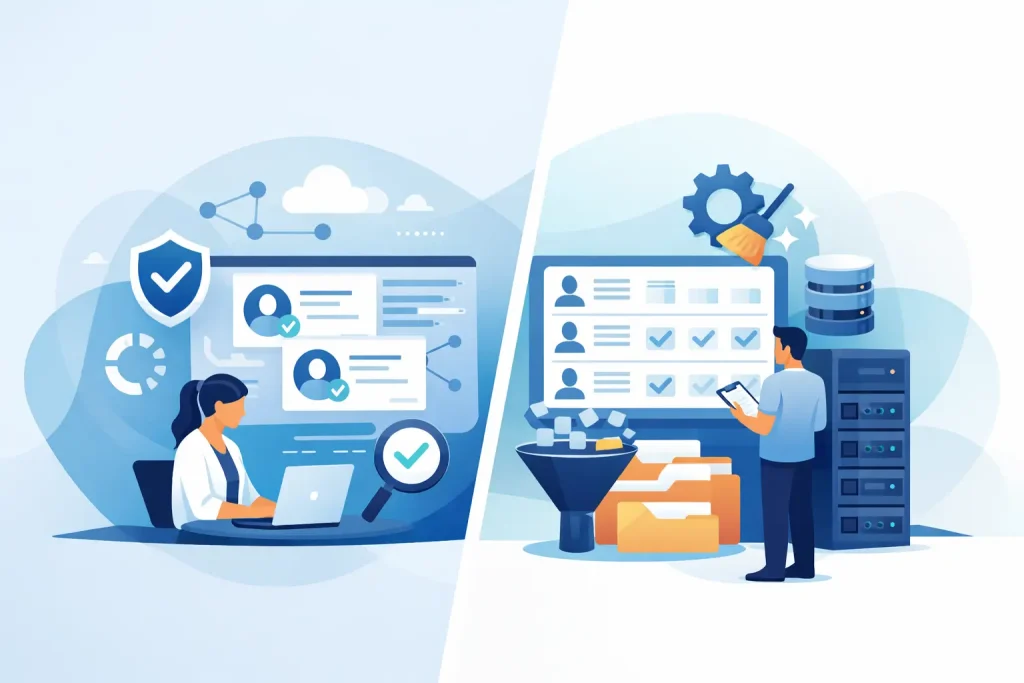
A lead form that accepts a fake phone number does not just create one bad record. It can waste paid media, send agents after unreachable consumers, pollute attribution, and create compliance exposure if that record gets routed into calling or texting workflows. That is why real time verification vs batch cleansing is not a minor systems question. It is a decision about where your business chooses to control data risk.
For teams that acquire, route, and act on consumer data at scale, the answer is rarely ideological. It is operational. Real-time verification and batch cleansing solve different failure points, and the right model depends on when bad data enters your systems, how quickly it creates downstream cost, and how much tolerance you have for remediation after the fact.
What real time verification vs batch cleansing actually means
Real-time verification evaluates consumer data at the point of capture or before a transaction moves forward. A phone number can be checked as a user submits a form. An identity signal can be reviewed before an account is created. An OTP can confirm possession before outreach begins. The goal is prevention.
Batch cleansing works on records after they have already been collected. Files are processed on a schedule or in bulk to identify invalid, stale, unreachable, duplicated, or risky entries. The goal is remediation.
That distinction matters because prevention and remediation produce different business outcomes. If a bad record is blocked before it enters your CRM, dialer, lender decisioning flow, or messaging platform, the cost is avoided. If the same record is cleaned later, some of the cost may already be realized.
Why timing changes the economics
The strongest case for real-time verification is that bad data becomes expensive very quickly. In lead generation, one invalid submission can trigger platform events, routing logic, enrichment calls, agent activity, and outbound contact attempts within seconds. In messaging environments, poor phone quality can affect deliverability, complaint rates, and carrier reputation. In regulated workflows, one non-compliant outreach event can create legal exposure that is far more expensive than the record itself.
Batch cleansing has a different economic value. It improves the quality of existing databases, purchased files, historical CRM records, and legacy systems that were never validated properly at intake. If your organization already holds millions of records, real-time controls alone will not fix the inventory you have. Batch processing is often the only practical way to restore baseline quality across old data.
This is why the comparison should not be framed as which method is better in the abstract. The more useful question is where the cost of bad data hits your operation first.
Where real-time verification wins
If you buy traffic, collect leads, route inbound submissions, or authenticate users in-session, real-time verification usually delivers the clearest return. The reason is simple. It stops low-value or risky records before they trigger spend and workflow activity.
Marketing teams benefit because media dollars stop funding form fills that cannot be contacted or should never have passed intake. Call center teams benefit because agents spend more time on reachable consumers and less time working dead records. Compliance teams benefit because identity and phone checks can support policy enforcement before outreach begins, not after complaints arrive.
There is also a systems advantage. Real-time verification makes downstream data cleaner by default. Your CRM, attribution layer, dialer, CDP, and messaging systems inherit better inputs. That reduces the need for constant cleanup, manual suppression rules, and exception handling later.
That said, real-time controls can add friction if they are implemented poorly. Overly strict rules can suppress legitimate users, especially when verification logic is not aligned to the actual risk of the workflow. A checkout form, a lead form, and a high-risk account opening flow should not all use the same threshold. Good real-time design is precise, not heavy-handed.
Where batch cleansing still matters
Batch cleansing is often treated as the old way of solving data quality, but that misses its value. It remains essential when the problem is not just new intake quality but the condition of your existing database.
A lender with years of historical applicant records, a contact center inheriting multiple vendor files, or a marketing team working through legacy CRM data needs bulk correction. Phone status changes over time. Consumers change carriers, disconnect lines, or reuse numbers. Addresses and identities drift. Consent records become harder to trust when source quality is inconsistent.
In those environments, batch cleansing helps teams recover operational control. It can reduce wasted outreach on aged data, improve segmentation, support reactivation campaigns, and identify records that should be suppressed before another compliance-sensitive touchpoint. It also fits organizations that operate on file-based workflows, use older systems, or need periodic audits rather than live API decisions.
The limitation is timing. Batch cleansing can improve what you have, but it cannot prevent the first wave of damage from bad records already accepted into production.
Real time verification vs batch cleansing for compliance
Compliance is where the timing difference becomes especially important. If your organization makes calls, sends texts, uses OTP authentication, or relies on identity signals for eligibility and fraud controls, the question is not just whether data is accurate. It is whether your validation process is defensible.
Real-time verification gives you a stronger operational position because you can apply checks before an action occurs. That supports better routing decisions, better suppression logic, and cleaner audit trails tied to the moment of consent, submission, or authentication. For teams that need to prove process discipline, this is a meaningful advantage.
Batch cleansing can support compliance too, especially in database hygiene projects and periodic file reviews. It helps identify stale or risky records before campaigns are launched. But if a record should never have entered a sensitive workflow in the first place, post-collection cleanup is a weaker control.
For many operators, the practical rule is straightforward. Use batch cleansing to reduce inherited risk. Use real-time verification to reduce newly created risk.
The best choice depends on your workflow
If your operation is high-velocity and event-driven, real-time verification should usually be the primary control layer. This includes lead marketplaces, paid acquisition funnels, lending applications, user onboarding flows, and outbound communication programs where each bad record creates immediate cost.
If your main challenge is a large backlog of questionable data, batch cleansing is often the right first move. It gives you a way to clean the house before enforcing stricter standards at the front door.
Most mature organizations end up using both. They verify at intake to prevent bad data from entering active workflows, then run batch processes on existing records to account for decay, status changes, and historic quality issues. That model is not redundant. It recognizes that data quality is not a one-time event. It is a control system.
How to think about the decision commercially
A useful way to evaluate real time verification vs batch cleansing is to map each method against a specific loss category. Ask where your organization is bleeding value today.
If the biggest problem is wasted ad spend, poor lead routing, fake submissions, agent inefficiency, or carrier risk from bad phone data, real-time verification usually has the fastest payoff. If the biggest problem is bloated CRM records, underperforming reactivation files, or legacy data contamination, batch cleansing may generate the first measurable improvement.
The technical delivery model matters too. API-first teams can deploy real-time checks directly into forms, product flows, and internal services. Organizations with legacy environments may prefer FTP or manual uploads for batch workflows until they modernize intake controls. The right infrastructure partner should support both, because data quality problems do not all originate in one place.
That flexibility is where providers like VeracityHub fit well. The value is not just access to verification signals. It is the ability to apply those signals at the right point in the workflow, with auditability and operational control.
A better question than which one is better
The wrong question is whether real-time verification replaces batch cleansing. The better question is where your organization can no longer afford delayed detection.
When bad data causes immediate spend, failed contact, fraud exposure, or compliance risk, prevention should come first. When historical data quality is already undermining performance, remediation needs to happen in parallel. Strong operators do not choose based on preference. They choose based on where data failure becomes business failure.
If you treat verification as infrastructure instead of cleanup, the decision gets clearer. Stop the damage early where you can. Repair what is already in the system where you must. That is usually where better conversion, lower waste, and tighter compliance start to show up.
