
How to Verify Purchased Leads Before Outreach
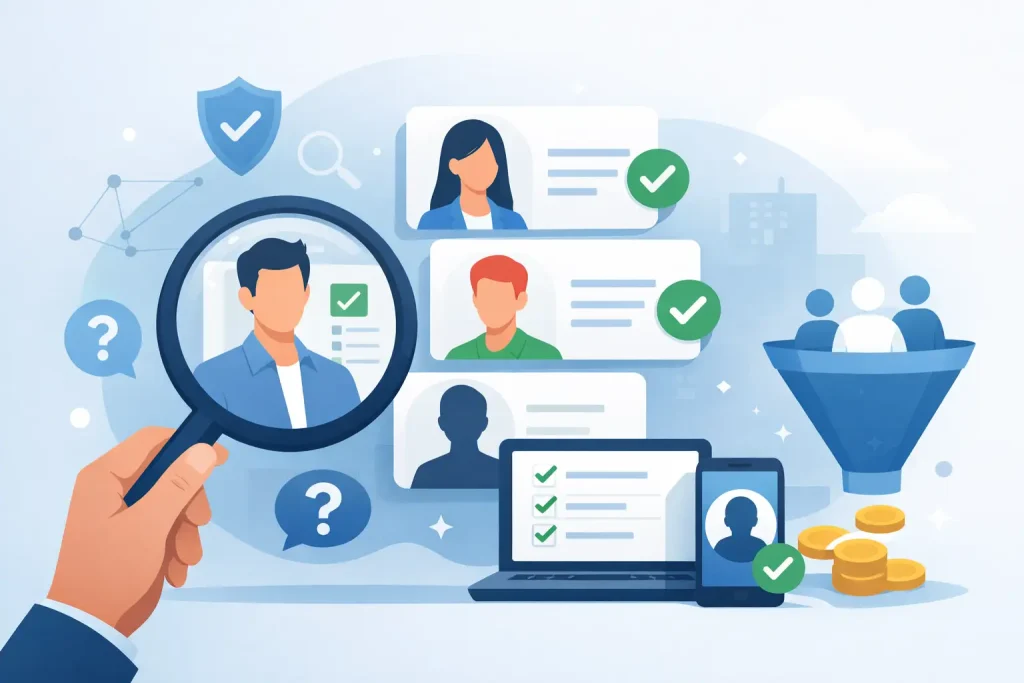
Purchased leads fail in predictable ways. The phone number is disconnected, the consumer never opted in, the record is duplicated across vendors, or the identity attached to the contact data does not hold up under basic validation. If you verify purchased leads before outreach, you catch those failures before they turn into wasted spend, low agent productivity, deliverability damage, and avoidable compliance exposure.
That matters because purchased data enters your workflow already carrying risk. Unlike first-party inbound traffic, you did not control the original point of capture, the verification standards applied at collection, or the chain of custody between source and delivery. A lead file may look complete on paper and still perform poorly in calling, texting, lending, or follow-up operations. Verification is how you separate marketable records from expensive noise.
Why purchased leads break downstream operations
Most teams feel the cost of bad leads in the wrong place first. Sales sees low connect rates. Marketing sees weak conversion. Contact centers see idle time between viable conversations. Compliance teams see consent gaps and documentation problems. Engineering teams inherit exceptions and retries that should never have reached production.
The root issue is simple: purchased leads are often evaluated on volume and unit cost, not on whether the records are reachable, attributable, and operationally usable. A record can pass a vendor’s basic formatting rules and still be a poor candidate for outreach. If the phone number is inactive, reassigned, or line-type mismatched for the campaign, outreach performance drops immediately. If the identity cannot be tied back to the consumer with reasonable confidence, risk increases just as fast.
There is also a timing issue. Lead quality decays. Numbers change status, consumers move, and intent goes stale. A file that looked acceptable at delivery can degrade before your team starts dialing or texting. That is why verification cannot be treated as a one-time procurement checkbox. It has to sit close to the moment of use.
What it means to verify purchased leads before outreach
To verify purchased leads before outreach is to test whether each record is fit for the exact channel and workflow you plan to use. That is more specific than generic data cleansing. You are not just fixing formatting errors. You are deciding whether the record should move forward, be suppressed, be enriched, or be routed for additional review.
For most B2B operators working consumer data at scale, that decision starts with phone validation. Is the number active? Is it mobile, landline, VoIP, or otherwise unsuitable for the planned outreach method? Has its status changed recently enough to create risk? These checks affect contactability, dialing efficiency, texting eligibility, and carrier reputation.
The next layer is identity confidence. Does the name, address, and phone relationship make sense? Can the record be appended or reverse matched to strengthen your confidence that you are reaching the intended person? If not, the lead may still count in a spreadsheet, but it should not count in a production campaign.
Then there is consent and compliance posture. Purchased lead vendors may provide attestation, but your operation still owns the downstream contact. If a record lacks clear auditability around capture source, timestamp, or intended use, that uncertainty should affect whether and how outreach proceeds.
A practical verification workflow
The strongest approach is staged, not one-dimensional. Start with intake controls before the file reaches agents or automation. Standardize fields, remove obvious duplicates, and normalize phone and address formatting. This is basic hygiene, but it prevents your verification systems from spending cycles on records that are already broken.
Next, run contact validation against the outreach channel. For phone-based campaigns, check whether the number is active and whether the line type supports your planned use case. This is the point where many teams recover immediate efficiency. Suppressing disconnected, invalid, or mismatched numbers improves connect rates without changing media spend.
After contact validation, run identity checks on the records that remain. This may include reverse lookup, data append, and identity verification steps that help confirm the person behind the lead. If your campaign has credit-sensitive or fraud-sensitive consequences, soft credit pull signals may also play a role in determining whether the record is suitable for the next step.
From there, assign disposition codes instead of using a simple pass-fail model. Some leads should proceed immediately. Some should be held for secondary review. Some should be routed to lower-cost channels. Some should be suppressed outright. Operationally, this matters more than a generic quality score because teams need clear downstream instructions.
Verify for the channel, not just the file
A common mistake is verifying a purchased lead as if all outreach channels carry the same requirements. They do not. A number that is technically valid may still be a poor candidate for SMS. A record that is usable for direct mail may be unsuitable for urgent call-center follow-up. Verification should reflect the outreach path, not just the existence of a contact field.
This is where compliance-aware workflows make a measurable difference. If your process can evaluate line type, status, identity confidence, and consent documentation before routing, you avoid sending questionable records into high-risk channels by default.
Use recency as a decision factor
Freshness is not a minor detail. Purchased leads lose value quickly when outreach is delayed. If your team buys data weekly but works it over a longer cycle, verification should be rerun close to launch or at least on high-risk segments. A phone number that was callable at ingest may not be callable by the time the campaign starts.
The practical standard is this: verify when the record enters your environment, and verify again when the cost of bad outreach is material. That second check is especially important for dialing, texting, lending, and any workflow where errors have direct financial or regulatory impact.
How to judge lead vendors after verification
Verification should not only clean the file. It should expose source quality. Once you verify purchased leads before outreach in a consistent way, vendor performance becomes easier to measure on operational outcomes instead of promises.
Start by comparing vendors on valid contact rate, active phone rate, duplicate rate, identity match rate, and compliant outreach readiness. Then measure downstream results such as connection rate, conversion rate, suppression rate, and agent time per qualified conversation. A lead source that looks cheap at acquisition can become expensive after verification and routing losses are applied.
This is also where internal alignment improves. Marketing can evaluate source economics with more precision. Sales and call-center leaders can forecast usable volume more accurately. Compliance gains a defensible record of why some leads were blocked or rerouted before contact.
Common trade-offs teams need to handle
There is no single threshold that fits every operation. If you tighten verification aggressively, you may reduce total reachable volume in exchange for higher efficiency and lower risk. If you loosen thresholds to preserve volume, your agents may work harder for weaker results, and your compliance exposure may rise.
The right balance depends on your margins, channel mix, and tolerance for uncertainty. High-cost outbound teams usually benefit from stricter suppression because every bad record consumes labor and dialing capacity. Lower-cost nurture programs may accept a broader population if controls are in place around channel selection and consent handling.
Another trade-off is speed versus evidence. Some teams want purchased leads routed immediately. That can make sense when lead intent is extremely time-sensitive. But if immediate routing means skipping phone status checks or identity validation, you are choosing speed over control. In many environments, a short verification step at intake protects more revenue than it delays.
Infrastructure matters more than one-time cleanup
The teams that get durable gains do not treat this as a periodic file audit. They build verification into intake and outreach infrastructure. That means real-time or batch validation based on how leads enter the business, clear routing logic for pass, review, and suppress outcomes, and audit-ready recordkeeping around what was checked and when.
This is where a modular verification layer tends to outperform manual review or disconnected point tools. If phone status, identity signals, reverse lookup, authentication, and delivery controls can work together, your operation makes better decisions before spend and contact attempts compound the cost of bad data. For organizations that buy leads at scale, that shift changes verification from a cleanup task into a control point.
VeracityHub is built for exactly that operating model, but the broader point applies regardless of stack choice: purchased leads should earn their way into production.
The shortest path to better outreach is not more volume. It is better admission control. When every purchased record is tested for reachability, identity confidence, and channel readiness before contact, your team stops paying to discover problems that should have been blocked at the door.
