
Why Validate Contact Data at Capture
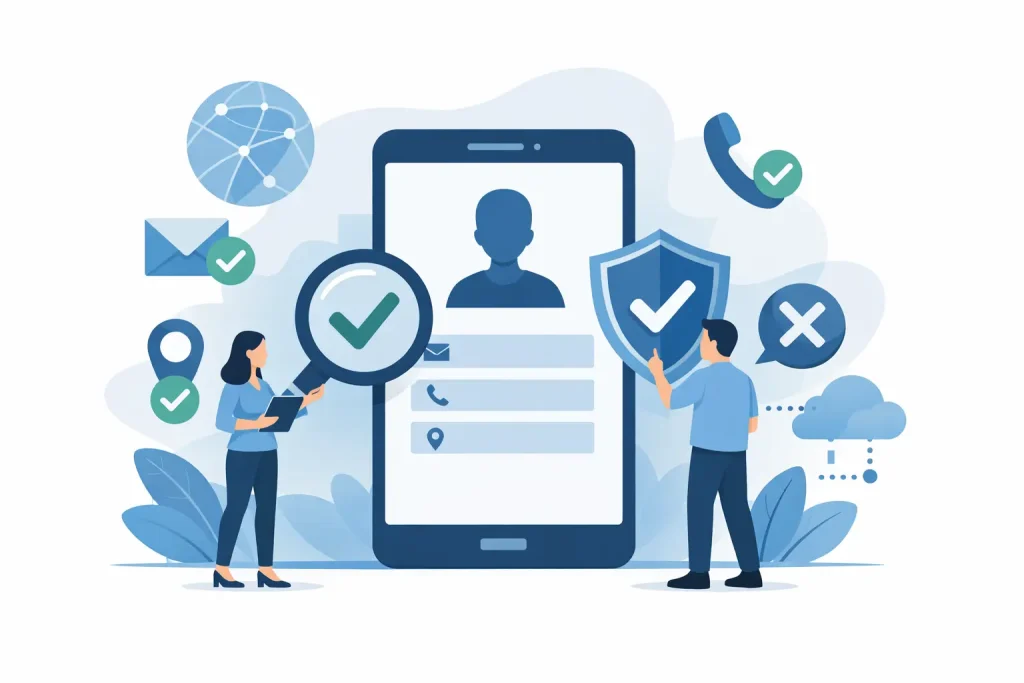
A lead form that accepts a mistyped mobile number is not a small data quality issue. It is the start of wasted media spend, failed SMS delivery, lower agent productivity, and avoidable compliance risk. Organizations that validate contact data at capture stop those problems before they enter sales, marketing, underwriting, or support workflows.
That timing matters more than most teams admit. Once bad contact data lands in a CRM, dialer, CDP, or lending queue, the damage spreads quickly. Paid acquisition teams keep funding sources that look productive on paper. Call centers work records that will never connect. Messaging programs send traffic toward invalid or reassigned numbers. Compliance teams inherit a mess they did not create but still have to defend.
What it means to validate contact data at capture
At capture means the moment a consumer submits information, whether that happens on a web form, lead marketplace, landing page, call center script, retail intake screen, or partner file feed. Validation at that point checks whether the submitted contact record is usable, reachable, and appropriate for the next workflow.
For phone data, that usually starts with basic structure and formatting, then moves into operational checks that matter in the real world. Is the number active? Is it mobile or landline? Has it been disconnected or ported? Is it associated with higher-risk behavior? Can it receive text messages? In some use cases, teams also need stronger identity alignment, such as confirming the phone has a plausible relationship to the consumer presenting it.
Email and postal data follow the same logic, but the business urgency around phone verification is often higher because calling and texting create immediate cost and compliance exposure. A bad phone number does not just reduce conversion. It can affect agent efficiency, carrier reputation, consent handling, and campaign performance.
Why waiting until after intake is expensive
Many organizations still run validation as a cleanup step. That approach feels operationally convenient because it does not interfere with the front-end user flow. The problem is that cleanup happens after the record has already triggered cost.
Marketing has already paid for the lead. Routing logic has already assigned it. Outreach systems may have already attempted contact. If the record is fraudulent or unreachable, the business has paid to acquire, process, store, and action data that should have been filtered out in milliseconds.
The cost is not limited to obvious bad records. Low-quality records are often more damaging because they appear usable long enough to distort performance reporting. Teams may believe a channel underperforms when the real issue is intake quality. They may blame agent execution when the contact data was never valid in the first place.
This is why point-of-capture verification belongs close to the source. The earlier the signal, the less rework the business absorbs.
Validate contact data at capture for conversion, not just hygiene
Some teams frame validation as a back-office data governance function. That is too narrow. The primary reason to validate contact data at capture is to improve operating performance.
When lead intake quality improves, conversion measurement improves with it. Sales teams spend more time on callable records. SMS programs reach real devices instead of dead endpoints. Authentication workflows succeed more often because the number on file can actually receive a one-time passcode. In lending and identity-sensitive environments, verified contact data also supports stronger fraud controls and cleaner downstream decisioning.
There is a trade-off, of course. Every front-end check introduces a decision point. If the workflow is too aggressive, you can create friction for legitimate consumers who made a harmless typo or are using a number that looks unusual but is still valid. The answer is not to remove verification. The answer is to design the right response.
In some cases, the correct move is hard rejection. In others, it is a prompt to correct the input, route to step-up verification, or flag the record for limited use. Good validation architecture does not treat every failed check the same way.
The signals that matter most at intake
Not every verification signal belongs at the point of capture. The best intake workflows focus on the checks that change immediate business decisions.
Phone status is one of the most useful. If a number is invalid, disconnected, or otherwise unreachable, the record should not proceed as if it were sales-ready. Line type is also critical because outreach and authentication strategies depend on it. A landline cannot be treated as an SMS destination, and VoIP numbers may require different risk handling depending on the use case.
Reassignment and ownership-related indicators can be equally important. A number that reaches a real device but no longer belongs to the intended consumer creates a different kind of risk than a disconnected number. The first can trigger wrong-party contact and compliance exposure. The second simply wastes effort. Both matter, but they should drive different downstream actions.
Identity linkage is where intake verification becomes especially valuable for regulated or fraud-sensitive workflows. If the submitted name, phone, and other consumer attributes do not align in a credible way, the business should know before that record enters underwriting, account creation, or outbound communication sequences.
Where teams get implementation wrong
The most common mistake is treating validation as a pass-or-fail utility call with no operational context. Verification only creates value when its outputs are mapped to real business actions.
For example, if a lead source consistently submits inactive or high-risk phone records, that should influence source scoring and buying decisions. If a record fails SMS eligibility but passes for voice, the routing layer should reflect that. If identity confidence is weak, the intake flow may need step-up authentication before the account is created.
Another common mistake is checking too little data, too late, and in too many disconnected systems. A marketing form may validate syntax, while the dialer checks line type later, and compliance reviews reassignment risk after outreach has already started. That fragmented model creates inconsistency and weak auditability.
A better approach is to centralize the decision logic at the point where records enter the business. That does not require a single technical method. Some organizations will use APIs in real time. Others need FTP-based processing or manual operational workflows because their stack is older or spread across business units. The important point is consistent policy enforcement.
Compliance is part of the intake design
Contact validation is often discussed as a deliverability or conversion issue. For many organizations, it is also a compliance control.
If your outreach program depends on calling or texting consumers, the quality of the phone record matters before the first touch. Reassigned number risk, line type classification, consent workflow design, and authentication all intersect at intake. A record that looks acceptable from a pure formatting standpoint may still be inappropriate for the intended communication channel.
That is why compliance-aware validation is different from generic data cleaning. It is not only asking whether the number exists. It is asking whether the number should be used in the way your workflow intends to use it, and whether you can defend that decision later.
Auditability matters here. Teams need records of what was checked, when it was checked, and what decision logic was applied. Without that, even a sound verification process is harder to operationalize across legal, marketing, and engineering stakeholders.
The commercial case is usually immediate
Most infrastructure investments take time to prove out. Validation at capture is different because the waste it removes is immediate and measurable.
You can see the impact in reduced bad lead acceptance, higher contact rates, fewer failed authentication attempts, cleaner routing, and better agent utilization. You can also see it in avoided costs that rarely show up in one dashboard: fewer calls to dead numbers, fewer texts to unreachable devices, fewer disputes over source quality, and fewer compliance escalations tied to contactability issues.
For organizations operating at scale, small percentage improvements compound quickly. A modest increase in reachable records can outperform a much larger spend increase on top-of-funnel acquisition. That is why commercially disciplined teams focus on intake quality before they focus on volume.
This is also where an infrastructure-minded partner matters. VeracityHub is built for organizations that need verification to function as an embedded control layer, not a one-off data append. That distinction matters when the same contact record may be used for marketing, authentication, servicing, and compliance review across multiple systems.
The practical question is not whether your business has bad contact data. It does. The question is where you want to absorb the cost – at the moment of capture, where it is cheapest to control, or downstream, where every bad record gets more expensive. The organizations that perform best rarely leave that decision to chance.
