
How to Improve Outbound Calling Data Hygiene
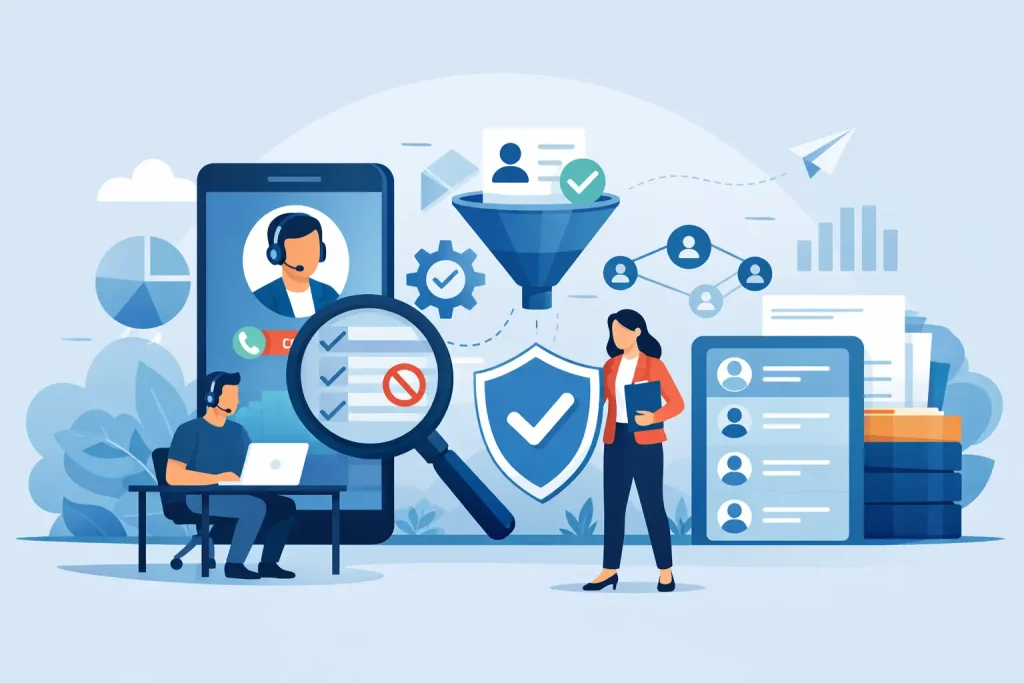
Every outbound team has seen the pattern: dial volume stays high, connect rates slide, agents spend more time working around bad records, and compliance risk creeps in through records that should never have been called. If you want to improve outbound calling data hygiene, the issue is rarely just list quality. It is usually a workflow problem that starts at data intake and compounds across enrichment, routing, suppression, and calling logic.
For operators, this matters because poor data hygiene is not a soft efficiency issue. It is a direct cost center. Invalid numbers consume agent time. Recycled numbers create wrong-party contact risk. Duplicate records distort reporting. Unverified lead submissions inflate acquisition metrics while reducing actual contactability. And when these records move downstream without controls, teams can damage carrier reputation, reduce answer rates, and expose the business to avoidable compliance failures.
What outbound calling data hygiene actually means
In practical terms, outbound calling data hygiene is the discipline of making sure each record is callable, attributable, current, and permissible before it enters or remains in a dialing workflow. That includes more than formatting numbers correctly. A clean record should reflect whether the phone number is valid, active, recently disconnected, associated with the expected consumer, and eligible to be called under your internal policy and regulatory obligations.
This is why simple CRM cleanup does not solve the problem. A number can look syntactically correct and still be operationally bad. It may be inactive, reassigned, or linked to incomplete identity data that makes consent and ownership harder to defend. Data hygiene for outbound calling is therefore a verification layer, not just a data management task.
Why bad calling data spreads so quickly
Outbound environments create contamination fast because records move through many hands and systems. Paid media forms, affiliate traffic, manual entry, purchased leads, batch appends, and legacy imports all introduce variability. Once a bad record enters the stack, it often gets copied into the CRM, marketing platform, dialer, QA tools, and reporting environment.
At that point, the same bad phone number can waste budget multiple times. Marketing counts it as a lead, sales counts it as an attempt, operations counts it as a productivity input, and compliance has to account for the outreach trail. One poor-quality record becomes several operational problems.
The fix is not to clean more often in a generic sense. The fix is to place verification controls at the points where data enters, changes, and gets activated for outreach.
How to improve outbound calling data hygiene at the source
The highest-return place to intervene is before records ever reach the dialer. Source-level verification catches bad data when it is still cheap to reject, route, or remediate.
Start with point-of-capture validation for web forms, call center intake, partner submissions, and lead imports. Verify phone number status in real time so invalid, unreachable, or suspicious records can be flagged before they enter production workflows. If the use case supports it, tie the phone record to identity signals such as name, address, and other available consumer attributes. This reduces the chance that a callable number is still a wrong-party risk.
Authentication also has a place here. For high-risk channels or high-value conversions, one-time passcode validation can confirm that the person submitting the number has access to the device. That does not replace broader consent and compliance controls, but it materially improves confidence in the record.
The trade-off is speed versus friction. Real-time checks add milliseconds and, in some cases, a small amount of user friction. For low-intent lead sources, that friction is often worth it because the cost of bad data downstream is higher than the cost of filtering aggressively upfront.
Improve outbound calling data hygiene with status checks and identity matching
Phone number verification should not stop at a simple valid or invalid result. Outbound teams need signals that are operationally useful. Is the number active? Is it recently disconnected? Is it likely to route as mobile or landline? Has ownership changed in ways that raise reassignment risk? Does the surrounding identity data support the assumption that the number belongs to the intended consumer?
This is where many teams underinvest. They treat phone data as a single field rather than a changing endpoint tied to a person, a device, and a compliance posture. Better hygiene comes from combining number status intelligence with identity matching and reverse lookup processes where appropriate.
That approach helps in several ways. It reduces wasted dials to dead numbers, supports better segmentation between call and text strategies, and creates stronger auditability around why a record was called. For regulated or high-scrutiny environments, that audit trail matters as much as the productivity gain.
Batch cleanup still matters, but it is not enough
Most mature teams inherit large volumes of historical data, so real-time controls alone will not fix the calling file. You also need recurring batch hygiene against stored records.
Batch processing is useful for identifying stale numbers, duplicates, incomplete identities, and records that no longer meet your call criteria. It is especially important before major campaigns, portfolio transfers, or dialer migrations. If you upload an aging file into a fresh outreach motion without re-verifying it, you are importing old risk into a new channel.
Still, batch cleanup has limits. It is periodic by design, which means quality can decay between runs. The best model is a layered one: validate at intake, re-verify before activation, and monitor stored records on a recurring basis. That gives you both prevention and maintenance.
Build decision rules, not just cleaner records
A common mistake is treating hygiene as a data team responsibility only. Clean data has value only when it changes how the calling program behaves.
Operationally, that means translating verification outputs into decision rules. Records with inactive numbers should be suppressed or routed for remediation. Numbers with uncertain ownership may require additional review or alternate contact strategy. Duplicate identities should be resolved before assignment to agents. Records that fail internal compliance thresholds should never enter the dial queue.
This is where infrastructure matters. Verification signals need to flow into the CRM, dialer, lead router, and compliance systems in a way that is usable by operations. API delivery is ideal for real-time environments, but batch and file-based delivery can still support strong controls in legacy stacks. The right integration method depends on your architecture, not on a generic best practice.
Measure the right outcomes
Teams often say they want better data hygiene when what they really want is better contact rates or lower cost per conversion. That distinction matters because it changes what you measure.
If you are trying to improve outbound calling data hygiene, track metrics that connect verification to business outcomes: invalid rate at intake, active number rate, duplicate rate, right-party contact rate, attempts per contact, agent handle time lost to bad records, and suppression volume tied to compliance rules. If carrier reputation and answer rates are part of your operating model, monitor those alongside data quality inputs.
Not every improvement will show up immediately as more conversions. Sometimes the first gain is negative space – fewer wasted dials, fewer agent escalations, fewer questionable records in QA, fewer compliance exceptions. Those outcomes are still commercially meaningful because they reduce hidden operating cost.
Where governance usually breaks
Most data hygiene failures are not caused by lack of tools. They come from unclear ownership. Marketing acquires leads, sales works them, compliance sets policy, engineering manages integrations, and operations owns performance. If no one owns the verification policy across that chain, exceptions accumulate and standards drift.
A stronger model assigns clear control points. Define what must be verified at intake, what must be rechecked before outreach, what triggers suppression, and what gets logged for audit. Then make those rules visible across teams. Hygiene standards that live only in a spreadsheet or one manager’s inbox will fail under volume.
This is one reason infrastructure-led verification tends to outperform ad hoc list cleaning. It turns quality expectations into enforceable system behavior instead of informal process.
The practical standard for cleaner outbound data
A workable standard is straightforward: verify early, verify again before action, connect verification to routing and suppression rules, and keep an auditable record of what was checked and why. For organizations calling at scale, anything less usually leaves too much room for waste and exposure.
VeracityHub fits this model because verification can be applied in real time or through batch workflows, with delivery options that accommodate both modern platforms and older operational environments. That flexibility matters when the goal is not just cleaner records, but cleaner execution.
The teams that get outbound calling data hygiene right are not chasing a perfect database. They are building a system that makes bad records harder to enter, easier to identify, and less likely to create cost once they do. That is the difference between occasional cleanup and a calling operation that stays reliable under pressure.
