
How to Screen Fake Applicants Before They Cost You
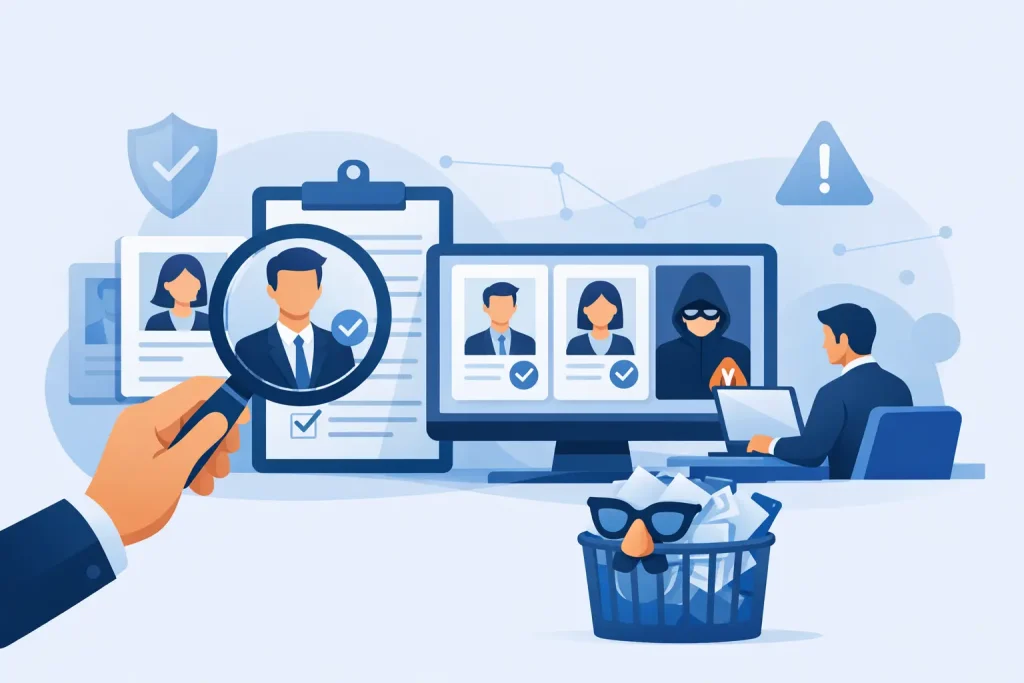
A fake application rarely arrives with a warning label. It looks like a completed web form, a new account request, or a lead ready for immediate outreach. The difference becomes visible later: agents reach disconnected numbers, verification messages go unanswered, records cannot be matched to a real consumer, or a fraudulent applicant reaches a downstream workflow. Knowing how to screen fake applicants at intake prevents those costs from spreading across media, sales, fraud, and compliance operations.
The objective is not to reject every unfamiliar or imperfect record. Consumers change numbers, use alternate email addresses, and may have thin files or limited digital histories. The objective is to identify records that are invalid, synthetic, unreachable, unauthorized, or inconsistent enough to require step-up verification before they are treated as legitimate.
Why fake applicants create more than a fraud problem
For lead generation teams, fake submissions distort campaign reporting. A source may appear to produce volume while generating unusable records that agents cannot contact. For call centers, invalid phone data lowers connect rates and consumes agent capacity. For lenders and financial services operators, identity inconsistencies can become fraud losses, adverse action issues, or gaps in a required audit trail.
There is also a communications risk. Repeated attempts to reach invalid, reassigned, or mismatched numbers can damage carrier reputation and reduce the effectiveness of legitimate calling and texting programs. When bad records enter a CRM unchecked, they are not merely a data-quality issue. They affect routing decisions, conversion forecasts, compliance controls, and the cost to acquire a customer.
The strongest screening programs treat verification as an operational control at the point of capture, not a cleanup exercise after data has already been distributed.
How to screen fake applicants with layered controls
No single signal proves an applicant is fake. A valid phone number does not confirm the person using it. An identity match does not necessarily establish that the person completing the application controls the device or number provided. Effective screening combines independent checks and uses the result to determine whether to accept, challenge, hold, or reject a record.
Verify phone status before the record is routed
Phone verification should occur as soon as a number is submitted, particularly where calling or texting is central to the workflow. Confirm whether the number is valid, active, reachable, and appropriately classified for the intended use. A number that is malformed, disconnected, unreachable, or not suitable for a communication channel should not be routed to agents as a standard lead.
Phone checks can also identify operational mismatches. For example, a consumer submitting a mobile number but presenting signals associated with a non-mobile or high-risk line type may warrant a different verification path. This does not automatically mean fraud. It does mean the record should not receive the same treatment as a verified mobile contact.
The timing matters. Running a batch check days after form submission can improve database hygiene, but it cannot recover the agent time, SMS cost, or campaign spend already applied to bad records. Real-time checks allow organizations to stop, correct, or challenge the submission before it enters downstream systems.
Match identity attributes, not just individual fields
Fake applicants often use information that is plausible in isolation. A real-looking name, address, date of birth, and phone number may have been assembled from separate sources. The critical question is whether the attributes resolve to the same consumer with sufficient confidence.
Identity verification and reverse lookup processes can test relationships between the applicant’s name, address, phone number, and other available data points. A direct match supports a low-friction path. A partial or conflicting match may call for additional authentication. A record with no credible match, especially when paired with other warning signs, should be held from high-risk workflows.
Build rules around the strength of the match rather than relying on a simple pass or fail. An exact match across multiple attributes is materially different from a name-only match. This approach gives operations teams a more useful decision framework and reduces unnecessary rejection of legitimate applicants with recently updated information.
Confirm possession with one-time passcodes
Identity matching answers whether applicant data is consistent with known records. One-time passcode authentication answers a different question: does the applicant currently control the phone number they submitted?
Sending an OTP during application or account setup can block a large share of low-effort fake submissions, including forms populated with random or scraped contact details. It is particularly valuable before granting account access, scheduling high-cost sales follow-up, issuing incentives, or allowing changes to sensitive account information.
OTP is not a complete fraud defense. Sophisticated fraud can involve compromised devices, SIM swaps, or social engineering. But possession confirmation is a meaningful control when used alongside identity and phone-status checks. The requirement should also match the risk. Requiring an OTP for every low-value content request may suppress legitimate conversion, while skipping it for a credit, lending, or account-access event creates avoidable exposure.
Use application behavior as a routing signal
Behavioral signals are most useful when they support verification data rather than replace it. Rapid repeat submissions, multiple applications from the same device pattern, unusually fast form completion, repeated use of similar addresses, or a high concentration of applications from one source can indicate automated or organized activity.
These signals should trigger proportional action. A burst of submissions from a paid campaign could reflect a bot attack, but it could also reflect a legitimate partner promotion. Instead of permanently blocking every anomalous pattern, route it to a verification step, apply rate limits, or temporarily hold records for review.
Organizations should also preserve the reason a record was challenged. If a form was held because the phone was invalid, the identity fields conflicted, and the submission velocity was abnormal, those reasons should be available to fraud, compliance, and campaign teams. Auditability makes it possible to refine controls without relying on anecdotal decisions.
Design a decisioning workflow, not a pile of checks
The common failure is collecting verification results without connecting them to a clear operational action. A practical model uses several outcomes: accept and route, request additional verification, hold for manual review, or suppress from outreach and downstream processing.
A low-risk record might have an active phone, a strong identity match, and completed OTP verification. It can move directly to the appropriate sales, onboarding, or service workflow. A record with a valid phone but a partial identity match may receive a step-up challenge instead of an immediate rejection. A disconnected number combined with conflicting identity data may be suppressed before it reaches a dialer or SMS platform.
This model should be configured according to the cost of a false positive and false negative. A consumer lender may tolerate more friction to prevent identity fraud. A high-volume lead buyer may prioritize rapid filtering of unreachable records while reserving manual review for high-value prospects. There is no universal threshold, but there should be a documented threshold for each workflow.
Protect compliance while you screen
Screening controls must be designed with permissible use, consent, retention, and access requirements in mind. The more sensitive the consumer data and the higher the consequence of a decision, the more disciplined the process must be. This is particularly relevant when a workflow includes credit-related data or any process that could affect a consumer’s access to financial products.
Use only the data necessary for the stated verification purpose, limit access to teams with an operational need, and retain decision records according to established policies. If soft credit pull capabilities are used, ensure the use case, consumer disclosures, authorization, and downstream handling are aligned with applicable requirements. Verification is not a substitute for compliance governance. It is part of the evidence that a workflow operated as intended.
Teams should also distinguish between a fraud-screening decision and a marketing eligibility decision. A record that fails contactability checks may be inappropriate for immediate outreach, but that does not always establish fraudulent intent. Precise labels prevent overbroad suppression and help teams explain why a record was routed or stopped.
Measure screening performance after launch
A screening program should be monitored like any other revenue or risk control. Track invalid-phone rates, identity-match distributions, OTP completion rates, agent connect rates, duplicate submissions, manual-review outcomes, and confirmed fraud by acquisition source. Compare these metrics before and after controls are introduced, then review performance by channel, partner, campaign, and application type.
Watch for friction that is concentrated among legitimate applicants. A sudden drop in OTP completion could indicate an application issue, a deliverability problem, or a customer segment that needs an alternate verification route. Likewise, a source with a high volume of valid phone numbers but poor identity matches may be sending incentivized or low-intent traffic rather than conventional fraud.
VeracityHub supports this approach by providing verification signals that can be applied in real time through API workflows or in batch through FTP and manual uploads. That flexibility matters when screening must work across modern intake forms, legacy CRMs, purchased lead files, and call-center operations.
The most effective applicant-screening programs do not assume every questionable record is fraudulent. They make uncertainty actionable. When verification happens before routing, your teams can spend their time on consumers who can be reached, authenticated, and served with confidence.
